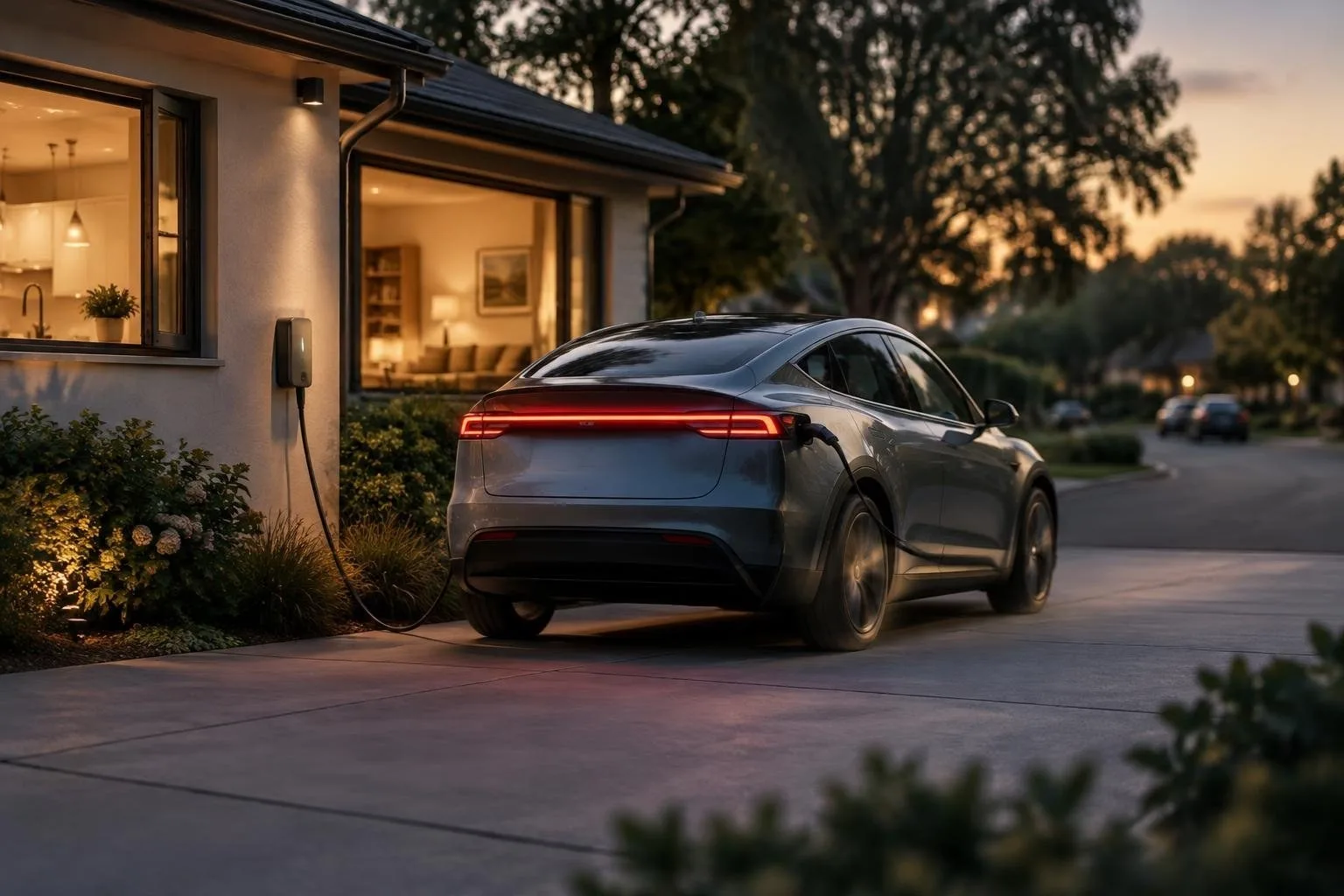
When the grid fails, an electric vehicle (EV) can do more than transport you — it can act as a portable energy storage unit for your residence. Homeowners across the United States have begun linking their EVs to house panels, enabling everything from a furnace to a dryer to stay alive during blackouts. The concept hinges on vehicle-to-home (V2H) technology, which lets the car’s battery discharge through a dedicated adapter and a bidirectional charger. While the idea sounds futuristic, real installations are already proving its practicality.
Real-world example: Hyundai Ioniq 5 paired with an S5000 power station
A Reddit user detailed how a Hyundai Ioniq 5 was integrated with an S5000 portable power station to supply their home during an outage. After installing a 30-amp breaker, a panel interlock, and a generator inlet, the homeowner disconnected from the utility grid. The S5000 then delivered 240-volt power straight to the house, while the Ioniq 5 fed the station through a vehicle-to-load (V2L) adapter. The power station reported a steady charging input of roughly 1,700 watts, enough to keep essential loads running. Average household demand settled near 1,000 watts; turning on the natural-gas furnace and electric dryer lifted consumption just past 2,000 watts. The user estimated that, with a fully charged battery, the setup could sustain the home for several days.
Technical prerequisites for a functional V2H system
The key to turning any EV into a backup source lies in three technical factors: battery capacity (kWh), maximum power output (kW), and bidirectional compatibility. Capacity determines how long the car can run appliances; a 60-kWh pack, for instance, could theoretically supply a 2-kW load for 30 hours. Power output governs which devices can operate simultaneously and whether the system can handle startup surges from compressors or motors. Crucially, the vehicle must support a reverse-flow charge via a dedicated V2H charger that includes a DC-to-AC inverter and an islanding/transfer switch. Standard Level-2 chargers cannot reverse current, so owners need a specific bidirectional unit such as the GM Energy PowerShift Charger, Kia’s Wallbox Quasar 2 combo, or Tesla’s PowerShare hardware.
Beyond the charger, the home’s electrical panel must be equipped with a safe disconnection mechanism—typically a panel interlock—to prevent back-feeding the grid. A 30-amp or larger breaker is common, and a compatible inlet (often used for generators) serves as the physical link. Installation usually requires a licensed electrician, and local permits may be needed, especially when the system exceeds 5 kW.
Planning your household’s backup power needs
Before spending on hardware, homeowners should audit which circuits are mission-critical. Start by ranking loads: heating (gas furnace with electric blower), refrigeration, communication devices, medical equipment, and pumps. Estimate the wattage of each and decide how long you need them to run. Data from Habitelligence shows that 44 % of families have experienced outages lasting 12 hours or more, and 24 % have endured multi-day blackouts. A typical winter storm driven by a strong El Niño—projected by NOAA to have a 70 % chance of being the most intense since 1950—can push demand for heating and lighting for several consecutive days.
Take inventory of existing backup assets: portable generators, standby generators, or home batteries such as the Guardian 6000. Note each unit’s fuel source, runtime, and power rating. An EV adds a flexible, mobile option, but remember the car must be at home, fully charged, and its battery life will be reduced by each discharge cycle. Heavy loads like electric water heaters or dryer circuits can quickly deplete a battery, so a combination of devices often yields the best resilience. For many, pairing a modest home battery (5-10 kWh) with an EV provides both short-term instant power and longer-term endurance.
Model availability and regional considerations
Not every electric car can act as a home power source. Currently, GM models, Kia EV9, Tesla Cybertruck and newer Model 3/Model Y with Powerwall 3 integration, as well as Polestar 3 (California only), offer officially supported V2H kits. Each ecosystem requires its own charger and software, meaning components are not interchangeable across brands. Prospective buyers should verify that the specific model year sold in their state includes V2H capability and that qualified installers are available locally. In California, university researchers are already field-testing EV-powered micro-grids that both supply backup electricity and shave peak-hour demand, underscoring the growing relevance of the technology.
Leveraging an electric car as a backup power source is technically feasible and can dramatically increase household resiliency during extreme weather. Success hinges on matching vehicle capacity, acquiring a certified bidirectional charger, configuring a safe panel interface, and thoughtfully prioritizing household loads. When executed correctly, a fully charged EV can keep lights on, the furnace humming, and even the dryer running for days without a single drop of fuel.