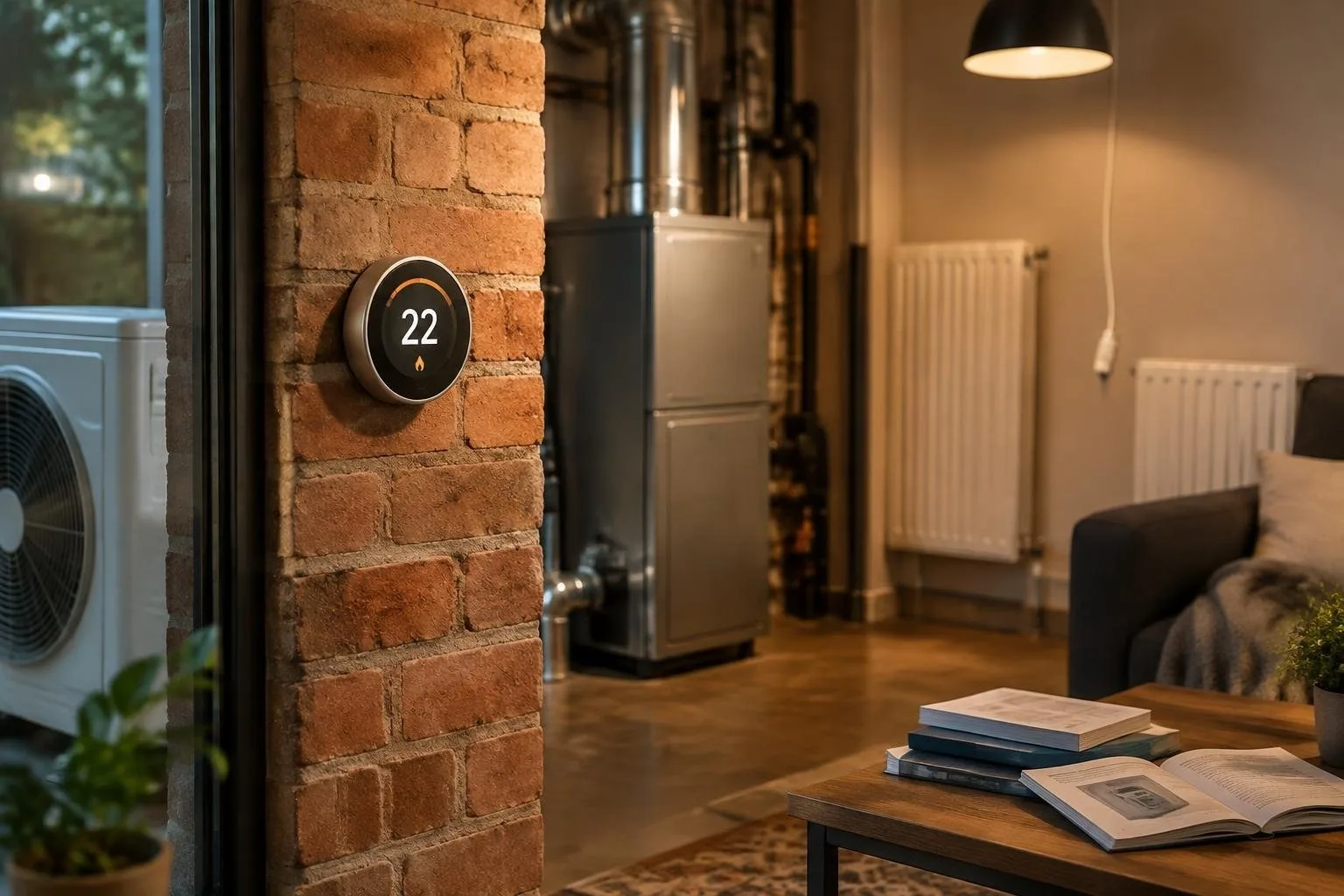
For many years the household thermostat acted like a basic on/off switch, simply activating a heating or cooling system when the indoor temperature drifted away from a preset point. The arrival of programmable and Wi-Fi models added convenience, yet the core purpose remained unchanged – maintaining a target temperature. Today, the combination of a heat pump with a natural-gas furnace in a dual-fuel layout has forced the thermostat to evolve into a true energy-management hub, capable of processing weather data, equipment efficiency and user preferences to decide which heat source should run at any moment.
Thermostats become the brain of dual-fuel heating
Modern controllers receive inputs from outdoor temperature sensors, the performance curves of the heat pump, and the cost signals of electricity versus natural gas. With these variables, the device can execute a set of configurable thresholds that determine a changeover point – the outdoor temperature at which it flips from the heat pump to the furnace or vice-versa. Manufacturers such as ecobee and Rheem expose parameters for contractors to fine-tune staging behavior, runtime limits, and auxiliary heat operation, allowing a highly tailored balance between comfort, efficiency and energy cost.
How the controller decides between heat pump and furnace
The decision algorithm resembles a mini-computer: it constantly compares the current thermal load of the house with the rated output of the heat pump at the measured outdoor temperature. If the pump can meet the demand, it stays active; otherwise the controller activates the gas furnace. Some systems also calculate an economic balance point, where the marginal cost of electricity equals the marginal cost of gas, and use that figure to shift the changeover temperature dynamically as utility rates fluctuate.
Optimizing performance with advanced features
Not every thermostat that claims “dual-fuel compatible” delivers the same depth of control. Devices like Honeywell Home FocusPRO and ElitePRO pair with Resideo’s Pro-IQ platform, offering remote diagnostics, equipment lockout adjustments and real-time performance dashboards. This remote visibility lets technicians refine staging strategies without stepping onto the property. Similarly, Copeland’s Sensi Touch provides custom compressor and auxiliary-heat lockouts, and can synchronize with the heat pump’s defrost cycle to fire the furnace briefly, preserving indoor comfort during the brief temperature dip that occurs in defrost mode.
Dynamic changeover and economic balance points
Traditional installations rely on a static outdoor temperature—often around 35 °F—to trigger the switch. However, newer heat pumps maintain full capacity well below 5 °F, and their efficiency can remain high when electricity prices are low. As a result, manufacturers now recommend that the thermostat offer a “dynamic” changeover, where the controller evaluates both the thermal balance point and the economic balance point before deciding. In regions with cheap electricity, the heat pump may continue to run even at –10 °F, while a spike in gas prices could push the system to favor the furnace earlier than a fixed threshold would allow.
Smart radiator and floor-heat controllers
Beyond central-plant coordination, the market for room-level smart regulators has expanded. The Bosch Thermostat II for radiators earned top marks in independent testing, scoring 1.49 overall and 1.10 for functionality. Its features include an offset calibration to correct sensor bias, a rapid “boost” mode for quick warm-up, geofencing that lowers heating when the house is empty, and automatic window-open detection that pauses output to avoid waste. The unit communicates over a reliable 868 MHz radio, can be commanded via the Bosch app, Alexa, Google Assistant or Apple HomeKit, and operates with either cloud or offline control.
Seamless smart-home integration
Floor-heating aficionados now have the Eve Thermostat, engineered specifically for water-borne underfloor systems. Released in summer 2026, the device relies on the Matter standard and Thread mesh networking, enabling truly local control without a cloud intermediary. Its silent Triac driver handles 230-V actuators, while an optional dry-contact relay accommodates legacy valves. Integration with Home Assistant lets users set precise temperature curves, and the built-in display provides continuous status feedback. The firmware (v 3.6.6) also offers a dedicated “triac” switch on the rear of the unit for easy conversion from relay mode.
Collectively, these advances turn the thermostat from a passive thermostat into an intelligent energy manager. By exploiting real-time weather data, equipment efficiency maps, and flexible pricing signals, modern controllers can keep homes comfortable while squeezing every possible kilowatt-hour or cubic-meter of fuel out of the system. At the same time, robust smart-Home compatibility and remote service tools give homeowners and technicians alike the confidence to embrace high-efficiency heat pumps, even in climates that once seemed too cold for all-electric solutions.