A study visit around Warsaw offered a look inside the factories, workshops and revived design icons hoping to make the country’s name as recognisable as its output.
Chances are something in your home was made in Poland. The flat-pack bookcase, the upholstered bench in a hotel lobby, perhaps the LED strip glowing under the kitchen cabinets. Yet ask most Britons to name a Polish furniture brand and the conversation tends to stall. That gap between ubiquity and recognition was the thread running through a study visit I joined in October with a small group of UK design and interiors writers, hosted by the Polish Investment and Trade Agency (PAIH).
Light, leather and lacquer
Our first stop was KLUŚ in Kolonia Lesznowola, just south of Warsaw, a lighting manufacturer whose products now reach more than 50 countries. Walking through its halls, what struck me was how much is made to measure: aluminium profiles, LED tapes and luminaires cut and assembled for specific architectural schemes rather than pulled off a shelf. Its design collection, all sculptural pendants and modular fittings, sits comfortably beside a thick technical catalogue, a pairing that architects clearly appreciate.
A drive west took us to WRS Interior Solutions at Brzozów, near Bielawy, where the mood shifted from product to project. WRS makes bespoke furniture and fit-outs for luxury retail and hospitality; its portfolio includes installations for fashion houses such as Dior and Valentino, and the complete furnishing of a 140-room Warsaw hotel, from lobby to guest rooms. On the workshop floor, stone, natural leather, high-gloss lacquer and steel were being brought together with real patience. This is the kind of supplier whose name rarely appears on a label, yet it quietly shapes how a flagship boutique feels when you walk in.

Icons revived, industry at scale
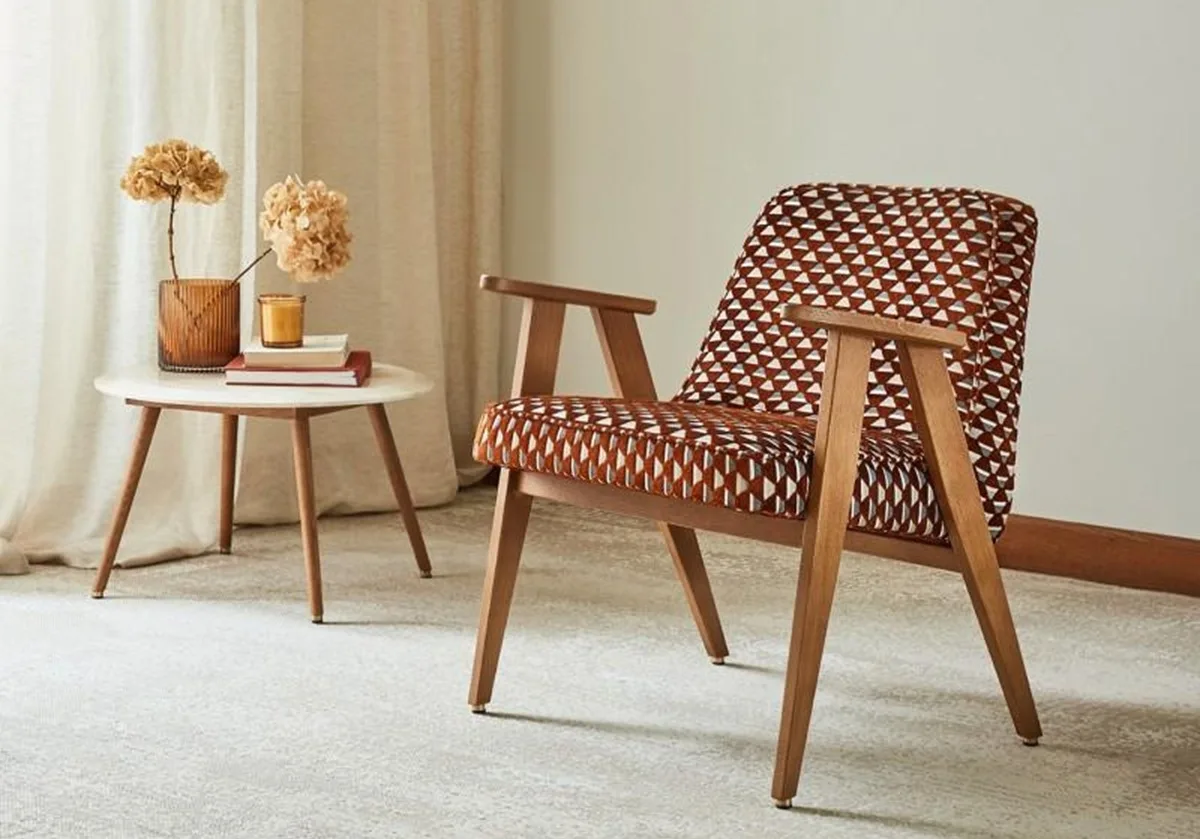
The next morning in Warsaw belonged to the past, reimagined. 366 Concept and Vzór have both built businesses on mid-century Polish designs that history left behind. 366 Concept reissues Józef Chierowski’s 366 armchair, a 1960s piece once found in almost every Polish café and office, under exclusive licence and from the original drawings. Vzór brought back Roman Modzelewski’s RM58, a 1958 fibreglass shell chair whose early prototype is held by the V&A in London; today it is made with composites borrowed from yacht building. Sitting in both, it was easy to picture them in a Hackney flat or a Marylebone members’ club.
Forte, in Ostrów Mazowiecka, offered the opposite end of the spectrum. Founded in 1992 and still family-run, it describes itself as Europe’s leading maker of self-assembly furniture: three Polish factories, automated board-cutting lines, more than 20 robots and around 2.1 million pieces of furniture sold in 2025. The UK is one of its key markets, with its own local trade team. Seeing that scale is a useful reminder that ‘made in Poland’ means industrial muscle as much as craft.
That evening we joined the opening celebrations for ‘Oskar Zięta. Proces’ at the Institute of Industrial Design. The exhibition traces two decades of Zięta’s FiDU technique, in which thin steel sheets are inflated into stable forms, from the Plopp stool to an ultralight vehicle frame. London audiences may know his Whispers installation, which opened the London Festival of Architecture in 2025.
A fair, and the people behind it
Our final day began at Warsaw Home & Contract at Ptak Warsaw Expo in Nadarzyn, now in its tenth edition and split across six zones, from furniture and lighting to textiles and kitchens. There we met Davis Fabrics from Bielsko-Biała, which showed upholstery fabrics alongside printing, quilting and laminating services for manufacturers. In the afternoon, the Creative Industries Institute explained how it funds, trains and promotes Polish designers and producers abroad: proof that someone is working on the recognition problem.
The numbers behind the names
The statistics explain why the visit felt overdue. According to the Polish Development Fund (PFR), Poland exported €16.6bn of furniture in 2025, a figure that includes lighting and bedding, and has been the world’s third-largest furniture exporter, behind China and Germany, since 2018. Bank Pekao calculates that it is the EU’s largest exporter, responsible for around 19 per cent of the bloc’s furniture exports. The UK is Poland’s fifth-largest market, buying roughly €1bn worth in 2025, or 6.2 per cent of the total. Pekao counts some 45,000 firms in the wood and furniture industry, employing more than 300,000 people.
The outlook is mixed. Exports fell by around 5 per cent in the first five months of 2026, and Pekao expects a recovering housing market to lift demand only from 2027–28. PKO Bank Polski forecasts the global furniture market to grow by about 2.5 per cent a year between 2026 and 2031. Perhaps the most telling figure comes from PFR: in early 2025 a tonne of exported Polish furniture was worth €3,850, against €6,690 for German furniture. That gap is the opportunity the people we met are chasing.